For ages 9-13. Register entries by 14 August, submit you film by 1 September 2026. See your film on the big screen and win $250 cash.
“The Waimakariri Young Environmental Film Makers (WYEFM) competition is a community-led initiative being organised by a small group of Waimakariri women with support from Rangiora Town Hall Cinemas, Waimakariri District Council greenspace team, the Waimakariri Biodiversity Trust, Eco Educate, and Enviroschools.
“The competition is open to Waimakariri primary school pupils, or home-schooled pupils, aged 10-13.
“It was inspired by two short environmental films, Plastic Straw Free Rangiora, which was made in 2018 by North Loburn School pupils, and Vote the Wrybill for Bird Of The Year, made last year by Pegasus Bay School pupils.” – Shelley Topp, ODT
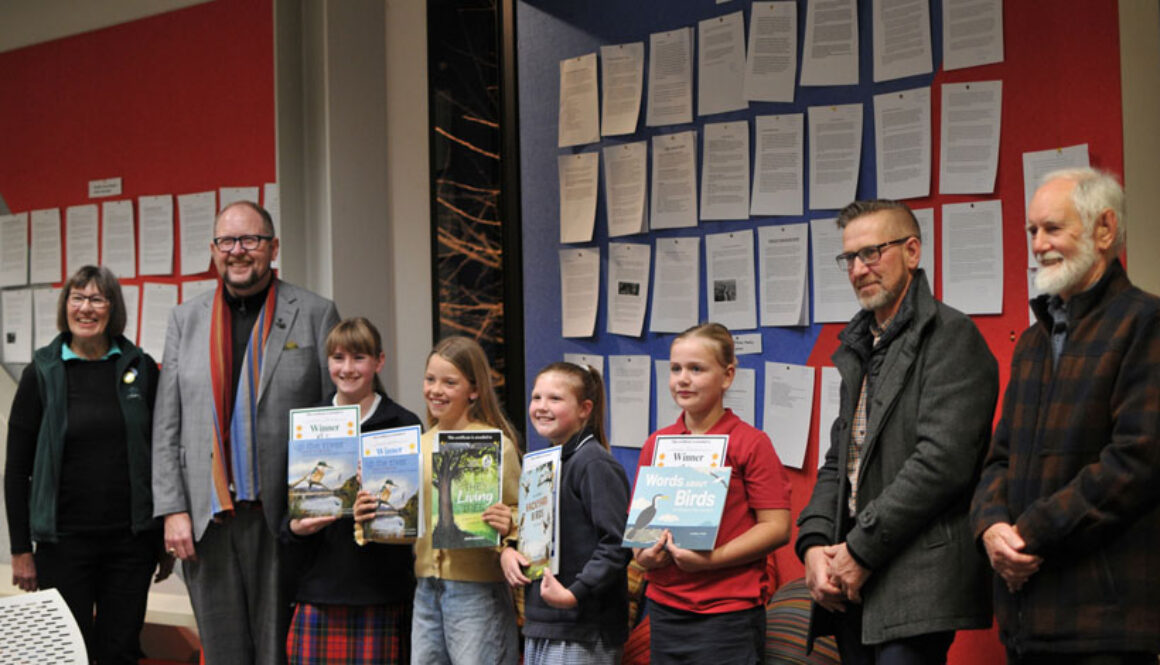
Top image from left to right: ARRG chairwoman Sue Mardon, Waimakariri Mayor Dan Gordon, the four section winners Charis Deane, Hazel Hobbs, Lily Anderson, Charli Jarvis, competition sponsor Jean-Pierre Derveaux, and one of the judges Pat White; May 21, 2026 Ashley-Rakahuri Rivercare Group’s Young Writers’ Competition Awards Night at the Kaiapoi Library. Photo: Shelley Topp.
Winners have been presented with their prizes in the Ashley-Rakahuri Rivercare Group Young Writers’ Competition.
Overall Supreme Award: Hazel Hobbs, age 10, Ohoka School. Hazel’s entry is below.
Winner of Section One Hazel also won the section for writing in the 10 years to 13 years age group.
The Overall Supreme Award winner Hazel Hobbs congratulated by Waimakariri District Mayor Dan Gordon. Photo: Shelley Topp.
Winner Section Two Writing 9 years and under: Lily Anderson, age 9, Ohoka School
WinnerSection Three Poems 10 to 13 years: Charis Deane, age 11, Rangiora New Life School
Winner Section Four: Poems from students aged 9 years and under: Charli Jarvise, 9, Tihiraki North Loburn School
ARRG is especially grateful to the sponsors, Ashley Gorge Holiday Park owners Jean-Pierre Derveaux and Michelle Tamaki, who have been very generous.
____________
Winning story:
ASHLEY-RAKAHURI RIVER By Hazel Hobbs Ohoka School 10 years old
The Rakahuri River is a rare type of braided river in Aotearoa. It is a beautiful slow flowing river that leads to an estuary and wetland and then on to the ocean. The nature surrounding the Rakahuri River is filled with endangered birdlife that depend on the river’s habitat to survive.
Wrybill
Have you ever seen a curved beaked bird? It is called a wrybill. They are the only birds in the world that have a sideways curved beak which is on the right and never on the left. They’re very well known for their camouflaging ability. If you are walking down the Rakahuri River you could easily walk straight past a wrybill, they look exactly like the rocks that they nest in. The Rakahuri River is one of the few rivers in New Zealand that have so many rare and endangered birds that call it home. There are many other endangered birds that live by the Rakahuri, some of which are the Black-fronted Tern, the Black Stilt, Black Billed Gull and the Banded Dotterel.
The river is important to the community because it serves lots of purposes. Our local iwi, Ngai Tahu, think of the Rakahuri as a taonga. Ancient Maori used the Rakahuri as one of their main food sources and called it the food basket or ‘kete kai’ of Kaiapoi Pa. The Rakahuri is important for flood protection, it has large stockbanks and is kept clear of woody weeds so when it floods it flows freely and protects the land and homes around it.
Across North Canterbury, many farming communities rely on the Rakahuri for irrigation to help grow crops and farmland. There are lots of people who spend time walking along the Rakahuri River, as well as camping and fishing around the river. It is a beautiful place to make memories.
I have explained why the Rakahuri River is so important, so how can we protect it and keep it thriving? First of all, we can make sure that we tell people how amazing and special the Rakahuri is. The more people that know about how rare it is to have a taonga like this in our community, hopefully the more people will do to protect it. In Te Ao Maori, we are all connected to nature because nature helps sustain us. We rely on nature to provide food and water and without our ecosystems these things could change in a bad way.
Placing things like large concrete blocks, as well as signs to stop motorbikes and cars from damaging nesting areas is a good tool to help the bird habitat. Helping community groups with predator control can help protect the endangered bird population too. Keeping large plants and weeds from blocking the river flow, is how we stop it from flooding into nearby farmland and homes. Supporting local projects and groups like the Rakahuri River Care Group, who put their time into improving the river for future generations is also very important. Without them, who would do all the work? One of the main things we can do as kids is trying to learn more about reducing greenhouse gases and trying to do better to stop climate change and global warming. If we start by protecting our local river, we can make a big difference.
The unique Rakahuri River connects all life, from the tiny wrybill to the people living around the river. By being the kaitiakitanga of this taonga, we are doing our best to protect the future of Aotearoa.
Have you ever lifted a stone on the river? Have you watched a bird dive into the water? Have you read books about river birds? Do you know what a ‘braided’ river is?
There is so much happening on the Ashley Rakahuri River! The Ashley-Rakahuri Rivercare Group (ARRG) is a group of volunteers working to protect and restore the river’s ecosystems. This year ARRG invites you to write an essay or poem for their annual Young Writers’ Competition.
Theme: “The Ashley-Rakahuri River is a taonga in our community. All life on the river is connected. How can we help the river thrive for future generations to enjoy?”
Eligibility: Open to primary school pupils in the Waimakariri District up to 13 years old
Section One: Essays from students aged 10 to 13
Section Two: Essays from students aged 9 and under
Section Three: Poems from students aged 10 to 13
Section Four: Poems from students aged 9 and under
Word count: Maximum 800 words essay or poem. No minimum word count.
Entry Dates: Entries open 16 March and close midnight 01 May 2026. Any entries submitted before or after these dates will not be considered.
Entries: Must include the following:
Name
Age
Section number
Contact details (phone or email)
Signed permissions from an adult
Signed declaration that it’s your own work
Signed declaration that AI was not used to generate any or all of the work
Author’s own original work; use of editing software such as Microsoft Word (editing only, not co-pilot) or Grammarly is okay but use of AI is not
May include up to 3 images, drawings, or figures
Information must be factual, not fictional
Judging will be by a team of three people
All entrants will be notified of results by email
By entering you agree that the Ashley Rakahuri Rivercare Group has the right to publish, reproduce and copy the entries
The winners’ works will be on the group’s official website and may be in other publications
Great Prizes:
Overall Supreme winner: two nights accommodation for a family of four in the Piwakwaka Suite at Ashley-Rakahuri Gorge Holiday Park plus a two-night stay in the Viking Barrell pod for 1-2 adults, kindly donated by the owners, Jean-Pierre Derveaux and Michelle Tamaki.
The Supreme winner also receives the book Up The River: Explore and Discover New Zealand’s Rivers, Lakes and Wetlands, by Gillian Candler and Ned Barraud.
____________
Winner of Section One: Essays from students aged 10 to 13 receives: Wildlife:An Animal History of Aotearoa, by Philippa Werry.
____________
Winner of Section Two: Essays from students aged 9 and under receives: Backyard Birds by Ned Barraud.
____________
Winner of Section Three: Poems from students aged 10 to 13 receives: Up The River: Explore and Discover New Zealand’s Rivers, Lakes and Wetlands, by Gillian Candler and Ned Barraud.
____________
Winner of Section Four: Poems from students aged 9 and under receives: Words about Birds by G.F. Fuller.
Part of the Overall Supreme Winner’s prize.
Nick Ledgard talking to students at Ohoka School about the birds of the Ashley Rakahuri.
I strutted along the warm rocky surface, searching for mayflies. The sun poured over the small stream ahead of me. I let out a loud “SCREECH” as a rumble of something struck me from behind. I flew upwards towards the sky, my wings flapped against the breeze. I glanced down and saw a motor bike driving along the Ashley Rakahuri Estuary, splashing through the braided streams, all connecting to the main river flowing out to sea. The motorbike sped away to the other side of the estuary. I slowly lowered myself down towards the rocky terrain, but to my horror I could hear the loud screams of another black fronted tern in trouble. I darted through the air and landed with a thud. The poor bird had a clear shiny thing stuck on its head. Instantly I recognized what it was – PLASTIC! To my horror the bird lay lifeless on the rocky surface. I was too late. So many birds and other animals have died from plastic and other litter. I turned around and flew towards my home on the west side of the estuary.
My partner will be silently incubating our three little eggs.
I plummeted down and landed silently next to her. “Did you have fun exploring?” she asked, giving me a smile.
“No – another tragedy.” Tears swelled in my eyes.
The sky grew darker as the sun set beyond the horizon. My partner moved off our nest made amongst the stones. Three little grey eggs were placed neatly in the middle. All of them were roughly the same size. I looked up. The stars and majestic half moon lit up the obsidian black sky. All of a sudden, I heard a loud screech of a ferret as it lunged towards the eggs out of the darkness. Then a deafening “PEK” of a gun shooting in the distance. The ferret – in mid air – fell to the ground lifelessly. I let out a long slow sigh of relief. Our eggs were somehow safe. But for how long?
The judges author Pat White, Waimakariri Arts Trustee & author Jackie Watson, and Judith Hughey, ARRG had a difficult task choosing winners from 72 entrants aged 8 to 12 years. All entries were displayed at the Kaiapoi Library where an awards evening was held. Mayor Dan Gordon presented the prizes with the first three prizes being a family weekend at Waikuku Beach Holiday Park, a family pass to Willowbank Wildlife Reserve, and a family pass to Rangiora Town Hall Cinemas. All winners were awarded certificates and small gifts to encourage their writing. ARRG is very grateful for the above sponsorship for the success of this competition. Ronan’s winning story is here.
FIRST: Roman Furer, 12 Ashley Rakahuri School SECOND: Manaia Stedman, 12 Rangiora Borough School THIRD: Elise Power, 12 Sefton School
Highly Commended:
Maya Thompson, Yr 8 Cust School Alandria Hepi, 12, Rangiora Borough School
10 YEARS AND UNDER Highly Commended:
Keiana Reuben, 8, Te Kura O Tuahiwi Ted Sole, 9, View Hill School Kerry Yates, 10, Rangiora Borough School Aston Smith, 8, View Hill School Tom Cahill, 9, Ohoka School Stella Muldoon, 10, Loburn School Matilda Perry, 8, View Hill School Elsi Lester, 8, View Hill School Mikae McNaughton, 10, Te Kura O Tuahiwi Flora Hoedemakers View Hill School Annabelle McDermott, 10 Loburn School Aine O’Sullivan, 10 View Hill School