2026 ARRG Young Writers’ Competition Winners
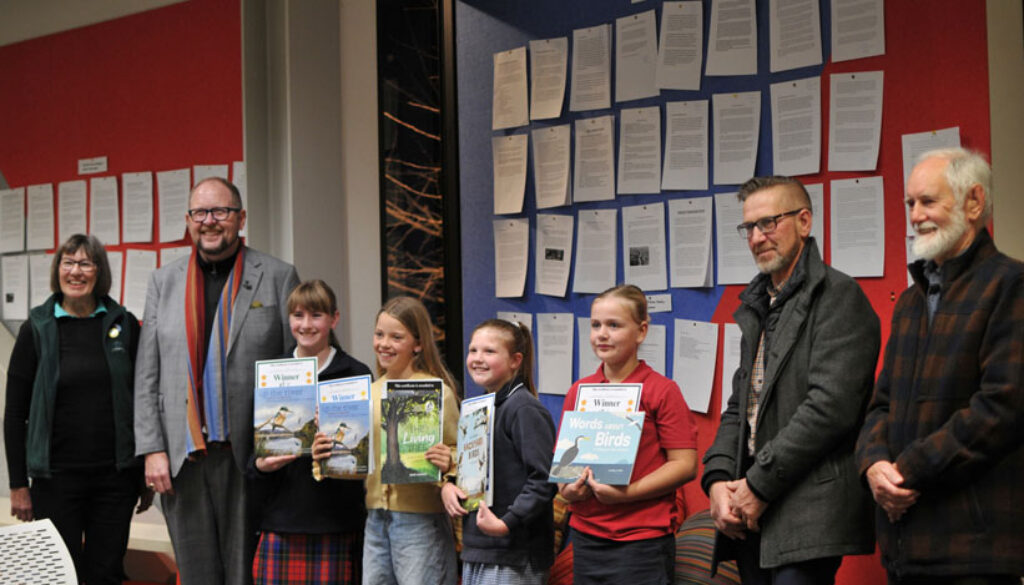
Top image from left to right: ARRG chairwoman Sue Mardon, Waimakariri Mayor Dan Gordon, the four section winners Charis Deane, Hazel Hobbs, Lily Anderson, Charli Jarvis, competition sponsor Jean-Pierre Derveaux, and one of the judges Pat White; May 21, 2026 Ashley-Rakahuri Rivercare Group’s Young Writers’ Competition Awards Night at the Kaiapoi Library. Photo: Shelley Topp.
Winners have been presented with their prizes in the Ashley-Rakahuri Rivercare Group Young Writers’ Competition.
Overall Supreme Award: Hazel Hobbs, age 10, Ohoka School. Hazel’s entry is below.
Winner of Section One Hazel also won the section for writing in the 10 years to 13 years age group.

Winner Section Two Writing 9 years and under: Lily Anderson, age 9, Ohoka School
WinnerSection Three Poems 10 to 13 years: Charis Deane, age 11, Rangiora New Life School
Winner Section Four: Poems from students aged 9 years and under: Charli Jarvise, 9, Tihiraki North Loburn School
ARRG is especially grateful to the sponsors, Ashley Gorge Holiday Park owners Jean-Pierre Derveaux and Michelle Tamaki, who have been very generous.
____________
Winning story:
ASHLEY-RAKAHURI RIVER
By Hazel Hobbs
Ohoka School
10 years old
The Rakahuri River is a rare type of braided river in Aotearoa. It is a beautiful slow flowing river that leads to an estuary and wetland and then on to the ocean. The nature surrounding the Rakahuri River is filled with endangered birdlife that depend on the river’s habitat to survive.

Have you ever seen a curved beaked bird? It is called a wrybill. They are the only birds in the world that have a sideways curved beak which is on the right and never on the left. They’re very well known for their camouflaging ability. If you are walking down the Rakahuri River you could easily walk straight past a wrybill, they look exactly like the rocks that they nest in. The Rakahuri River is one of the few rivers in New Zealand that have so many rare and endangered birds that call it home. There are many other endangered birds that live by the Rakahuri, some of which are the Black-fronted Tern, the Black Stilt, Black Billed Gull and the Banded Dotterel.
The river is important to the community because it serves lots of purposes. Our local iwi, Ngai Tahu, think of the Rakahuri as a taonga. Ancient Maori used the Rakahuri as one of their main food sources and called it the food basket or ‘kete kai’ of Kaiapoi Pa. The Rakahuri is important for flood protection, it has large stockbanks and is kept clear of woody weeds so when it floods it flows freely and protects the land and homes around it.
Across North Canterbury, many farming communities rely on the Rakahuri for irrigation to help grow crops and farmland. There are lots of people who spend time walking along the Rakahuri River, as well as camping and fishing around the river. It is a beautiful place to make memories.
I have explained why the Rakahuri River is so important, so how can we protect it and keep it thriving? First of all, we can make sure that we tell people how amazing and special the Rakahuri is. The more people that know about how rare it is to have a taonga like this in our community, hopefully the more people will do to protect it. In Te Ao Maori, we are all connected to nature because nature helps sustain us. We rely on nature to provide food and water and without our ecosystems these things could change in a bad way.
Placing things like large concrete blocks, as well as signs to stop motorbikes and cars from damaging nesting areas is a good tool to help the bird habitat. Helping community groups with predator control can help protect the endangered bird population too. Keeping large plants and weeds from blocking the river flow, is how we stop it from flooding into nearby farmland and homes. Supporting local projects and groups like the Rakahuri River Care Group, who put their time into improving the river for future generations is also very important. Without them, who would do all the work? One of the main things we can do as kids is trying to learn more about reducing greenhouse gases and trying to do better to stop climate change and global warming. If we start by protecting our local river, we can make a big difference.
The unique Rakahuri River connects all life, from the tiny wrybill to the people living around the river. By being the kaitiakitanga of this taonga, we are doing our best to protect the future of Aotearoa.